Digital Marketing User Experience UX

Why User Experience is Key to Digital Marketing Success

Step 1: Insert Coin

Step 2: Avoid Klingons

One of Atari’s early Star Trek video games from the 1970s had two simple steps. Their goal (and understanding of user experience) was that, in order to be successful, you needed to be able to have as few steps as possible for users to follow. In the time of arcade games, the consumers weren’t as savvy as they are today. This simple user experience was noticed by Steve Jobs when he worked there and later became an inspiration of his to revolutionize 6 different fields of technology, including computer user experience.

While today’s consumers are savvy, their brains are still wired the same way they have been for thousands of years. A lot of the best practices in user experience — simple steps and clean, elegant interfaces — go hand-in-hand with leading principles in neurobiology. A critical part of how your brand is perceived online is the experience in how easily a consumer can find, access, review, and buy from you.

An ideal customer journey is through a user-friendly website that contains seamless navigation, a clean-cut purchasing journey, easy-to-consume content, and works on whatever device they put it on. Just like the Atari principle, the fewer steps the user has to take, the better!

Mobile Devices and Other Technology

The rise of smartphones and mobile technology usage has changed the way people view, buy, and interact online.  With mobile now accounting for 65% of digital media time, the desktop is becoming the secondary touchpoint for an increasing number of digital users.

Mobile is so ingrained into the psyche of today’s user that mobile users are five times more likely to abandon their session if a website isn’t correctly optimized for their phone — and if you’re running a business, this could mean a major loss in conversions, or even damaging to your brand’s reputation.

That said, what’s more alarming is that 52% of users said a bad mobile experience made them less likely to engage with a company, and with 80% of local searches converting on mobile devices (if they are designed properly), UX is a principle that simply should not be ignored.

User experience is more than just usability

Simplicity’s importance cannot be overstated. While a lot of marketers shrug off user experience as an industry buzzword, that couldn’t be further from the case. Whether it’s choosing a simple font or using a simple guarantee, strive for simplicity in user experience.

User experience isn’t just a design concept. It’s an entire process of your users’ experience with your brand. Confusion, clutter and disorganization represent your brand in, well, a confusing, cluttered, and disorganized way! As a whole, user experience determines how a brand speaks to its customers and delivers the message the brand is trying to convey.

Where UX fits into the five tiers of content marketing

A content-based strategy that yields incredible results is always best planned from the ground up. There are three levels to a successful content marketing model:

  1. SEO: Essential.  If your site isn’t optimized for search engines, your target customers will never find you in the first place! Search engines are also getting more intelligent and feed off of principles of user experience to rank articles.
  2. Neural experience: Your customers need to have a journey and experience that engage with their brain. According to a study by Adobe, given 15 minutes to consume content, two-thirds of people would rather read something beautifully designed than something plain. That’s just one piece of the puzzle! 
  3. Content: You need to create content and media that meet the needs of your target audience. This content should trigger their unique brain patterns and hyper-focus on a target market. Creating and distributing this content is important in getting your message heard.

UI User Experience UX

UI, UX & NX: What’s the Difference Between User Interface, User Experience, and Neural Experience?

At the most basic level, the user interface (UI) is the series of screens, pages, and visual elements — like buttons and icons — that enable a person to interact with a program, product, or service.

User experience (UX) is the internal experience that a person has as they interact with every aspect of a company’s product or services.

Neural Experience (NX) is the integration of neurobiology into your brand’s digital touch points to engineer a more life-changing and spiritual experience for a brand’s customers, while turning their buying behaviors into a rewarding ritual, inspiring followers into influencers and congregates.

A Neural Experience helps brands achieve a higher connection with their customers. It’s things like neuroscientists discovering that, when comparing MRI scans of Apple fans’ brains to those of people who call themselves “very religious,” they found that Apple and religion light up the same part of the brain. 

In today’s post, we’ll dig a bit deeper into the three different arenas (UI, UX, and NX) and talk about how NX differentiates brands in a crowded marketplace of ever-changing competition.

What is UI?

User interface is anything a user may interact with to use a digital product or service. This includes everything from screens and touchscreens to keyboards, sounds, lights, animations, and everything in between. To understand the evolution, it’s helpful to learn a very brief history of the user interface.

A brief history of the user interface

In the 1970s, if you wanted to use a computer you had to use a command-line interface. A modern variation of a command-line interface looks like this:

21 CMD Commands All Windows Users Should Know

In the early 1980s, Microsoft and Apple both took the concept of a graphical user interface (GUI) from computer scientists at Xerox PARC. This groundbreaking intervention allowed users to interact with their computers by submitting commands with icons, buttons, menus, and checkboxes. It meant you didn’t have to be a “coder” to be able to use a computer. This GUI looked something like the below:

As computers continue to evolve, so do the UIs. You now have voice-activated user interfaces, where your voice fires off commands as the old command prompts did. Touchscreens and digital technology are evolving to allow users to interact with computers like never before.

What is UX?

User experience (UX) evolved as a result of improvements to UI. Technically, the Xerox concept of creating the GUI over the command prompt could be considered the first implementation of refined user experience. Xerox and other technical leaders at the time realized that a command prompt user interface can only go so far. An improved UI, swapping out icons and buttons for lines of code, made it easier for non-technical users to interact with computers.

Cognitive scientist Don Norman is credited with coining the term, “user experience” back in the early 1990s:

‘User experience’ encompasses all aspects of the end-user’s interaction with the company, its services, and its products.

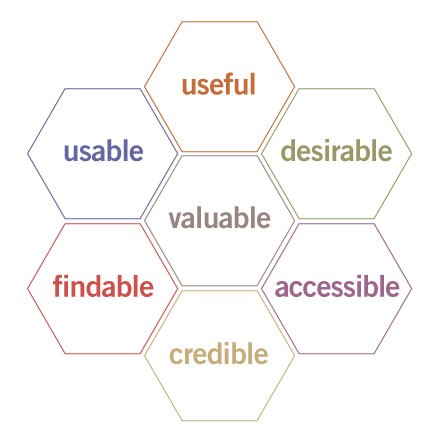
To understand what makes an experience a good one, Peter Moreville developed a great visual to highlight what goes into effective UX design.

Source: Peter Moreville

Source: Peter Moreville

This ‘usability honeycomb’ has become a foundation for best practices for UX professionals to guide their efforts across multiple touch points with the user, including:

  • How they would discover your company’s product
  • The sequence of actions they take as they interact with the interface (with the product)
  • The thoughts and feelings that arise as they try to accomplish their task
  • The impressions they take away from the interaction as a whole

What is NX?

Evolving even further, neuroscientists began to realize that there was a science behind good user experience. That an interaction with a brand can, in most cases, be broken down to helping the users’ reptilian brain better interact with a brand. Neural Experience relies on taking the principles of UX, and adding in theories from studies on how consumers interact with price and make purchasing decisions,  and how to understand how your customer’s brains work to get better results in your marketing and user experience with less money.

It’s about understanding that if you’re marketing to Boomers, you need to have a simple user experience. Studies by Adam Gazzaley showed that suppression difference in older versus younger brains was the key factor in memory formation decline in older people. Gazzaley found that older brains were far worse at suppressing irrelevant information. This means a busy or cluttered user interface, or asking the older brain to make too many choices, isn’t going to be the best Neural Experience for older users.

NX is also knowing that the bottom right corner is the worst place to put your company logo. An eye-tracking study by Steve Outing and Laura Rule found that the last place people look when observing something is the lower right corner. Many won’t even get that far if they aren’t engaged with other content on the page.

How do UI and UX feed into NX?

UI is made up of all the elements that enable someone to interact with a product or service. UX is what the individual interacting with the product or service takes away from the experience. NX uses principles in neurobiology to establish some foundational practices in the very vague concept of what an “individual interacting with a product or service takes away from the entire experience.”

Don Norman and Jakob Nielsen summed it up nicely when they said:

It’s important to distinguish the total user experience from the user interface (UI), even though the UI is obviously an extremely important part of the design. As an example, consider a website with movie reviews. Even if the UI for finding a film is perfect, the UX will be poor for a user who wants information about a small independent release if the underlying database only contains movies from the major studios.

NX, Neural Experiences, uses principles grounded in real brain science to give your brand a cutting edge in how your users interact with and buy from your brand. It’s about using data to tap into your customer’s brains and give them an experience as they’ve never had before.